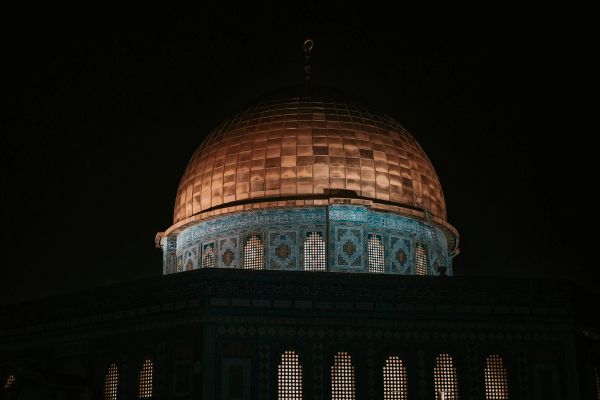
The virtues of the Al-Aqsa Mosque are numerous; one indicator that is often overlooked is the keenness of many notable Muslims to live and die as close as possible to the Al-Aqsa Mosque. Indeed, in my visit to the Haram al-Sharif, I visited the Muslim’s cemetery adjacent to the outer eastern wall of the mosque and was struck by the view and layout. The graves looked as if they were competing to be closer to the wall.
This eagerness is a translation to their understanding of the Qur’anic verse (1) in Sura Al-Isra:
)) سُبْحَانَ الَّذِي أَسْرَىٰ بِعَبْدِهِ لَيْلًا مِّنَ الْمَسْجِدِ الْحَرَامِ إِلَى الْمَسْجِدِ الْأَقْصَى الَّذِي بَارَكْنَا حَوْلَهُ لِنُرِيَهُ مِنْ آيَاتِنَا ۚ إِنَّهُ هُوَ السَّمِيعُ الْبَصِيرُ ((
[Exalted is He who took His Servant by night from al-Masjid al-Haram to al-Masjid al-Aqsa, whose surroundings We have blessed, to show him of Our signs. Indeed, He is the Hearing, the Seeing].
And we find a hadith where a Companion asked the Prophet ﷺ about where Muslims should settle if they lived after him:
“We said, ‘O Messenger of Allah, if we are tested with long life after you, where would you command us?’
He said,
‘Hold fast to Bayt al-Maqdis, for perhaps Allah will cause for you offspring who will go early and late to that mosque.’”
The narration is recorded in Musnad Ahmad, attributed to Dhī al-Aṣābiʿ (ذو الأصابع) with ‘Weakness’ in the chain
Indeed, we know from the historians that the descendants of the prophet’s companions buried there stayed, lived and prayed in the Al-Aqsa Mosque.
Notable Muslims who chose to be buried in or around Al-Aqsa :
1. Early Islamic Figures (Companions of the Prophet ﷺ):
Found in Bab al-Rahma Cemetery (along the eastern wall of the Al-Aqsa compound). The cemetery contains many early Islamic burials, including:
- Ubada ibn al-Samit (رضي الله عنه) – Companion of the Prophet Muhammad ﷺ; participated in major battles, including Badr and served as a judge in Palestine under Caliph ʿUmar. He is traditionally believed to be buried here.
- Shaddad ibn Aws (رضي الله عنه) – Companion of the Prophet ﷺ
- Numerous other Companions (Sahabah)
2. Political and National Figures
Several notable 20th-century figures are interred near in the Al-Aqsa compound:
- Muhammad Ali Jauhar (محمد علي جوهر) – Indian Muslim leader of the Khilafat Movement and prominent campaigner for Muslim rights; buried in the Al-Aqsa compound following his death in 1931.
- Abd al-Qadir al-Husseini – Palestinian commander during the 1948 Palestine war; buried at Al-Aqsa vicinity.
- Prince Mohammad Ali Al-Hindi – Indian prince and defender of the Palestinian cause; buried inside the Al-Aqsa compound.
3. Other Burials in Areas Adjacent to Al-Aqsa
Ma’manullah / Mamilla Cemetery (just outside the Old City/Al-Aqsa)
Although distinct from the Haram al-Sharif precinct, this historically important Muslim cemetery contains numerous prominent figures:
- Emir Nasser al-Din al-Nashashibi – Saladin’s minister and later custodian of Masjid al-Aqsa.
- Dia’ al-Din Issa al-Makari – Saladin-era scholar and official.
- Sheikh Shihab al-Din al-Maqdisi – Theologian.
Summary
Bayt al-Maqdis is one of the three sacred mosques in Islam, alongside al-Masjid al-Haram and al-Masjid al-Nabawi. Narrations encouraging attachment, residence, and frequent visitation reflect a consistent Prophetic orientation toward Jerusalem’s spiritual centrality. The fact that many prominent Islamic figures, such as the Prophet’s companions and scholars from different eras, wanted to live and be buried there emphasises intergenerational continuity, reinforcing the idea that Al-Aqsa is not a symbolic site only, but a lived religious space.